Home > NEWS > Industry Information > Views
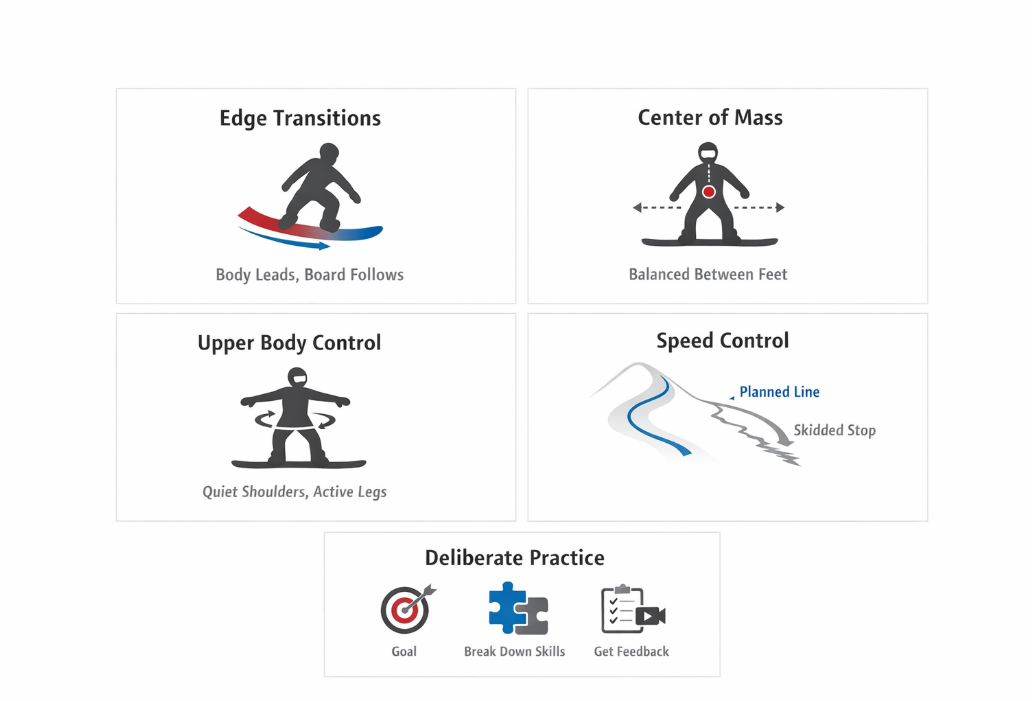
After reaching an intermediate level in snowboarding, many riders experience a similar plateau:
You can link turns, ride blue runs comfortably, but as speed increases or terrain gets steeper, control starts to fade and confidence drops.
At this stage, the limitation is rarely courage or physical strength.
More often, it’s a lack of system-level understanding of movement.
Here are a few mindset and technique shifts that made the biggest difference in my own progression.
At the beginner level, edge change is often taught as “pressing” with the feet.
At the next level, you realize that clean transitions come from coordinated movement across the ankles, knees, hips, and torso.
The body initiates direction; the board follows naturally.
This mirrors many professional environments:
when the system is aligned, outcomes emerge with far less friction.
As speed and terrain difficulty increase, stability depends almost entirely on consistent weight distribution:
Centered between both feet
Slightly biased toward the front foot
Avoiding the instinct to sit back under pressure
Once the center of mass is compromised, technique breaks down quickly.
Snowboarding reinforced a practical lesson for me:
Stability is not about being conservative — it’s about understanding and actively managing risk.
One clear trait of advanced riders is how calm their upper body appears:
Shoulders stay aligned with the board
Turns are initiated from the lower body, not by forcing rotation
Reducing unnecessary movement dramatically improves consistency.
In any complex system, eliminating excess input is often the fastest path to higher efficiency.
Beginners rely heavily on skidding to manage speed.
Progression comes from learning to control speed through:
Turn shape
Edge angle
Line selection
This represents a shift from reactive control to proactive planning — on the mountain and in work alike.
At the intermediate stage, improvement doesn’t come from simply riding more laps.
What works better:
Breaking skills into isolated components
Training with a specific objective each session
Practice with feedback compounds; repetition without intention does not.
Snowboarding progression is ultimately a shift from executing movements to managing a system.
When you stop focusing on avoiding falls and start thinking about how to make each line smoother, more stable, and more efficient, you’ve entered a new phase of growth.
That mindset extends well beyond sport — it applies directly to long-term professional development.