Home > NEWS > Industry Information > Views
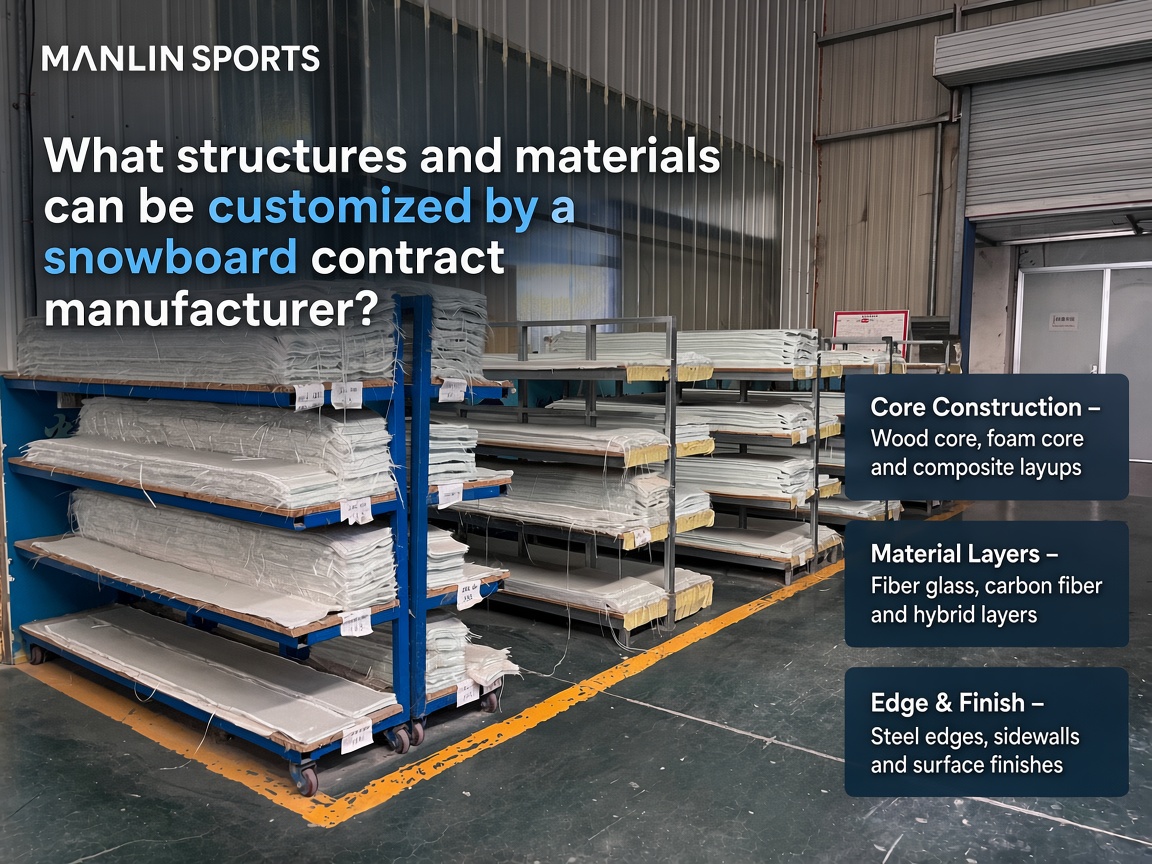
For companies planning to develop their own brand, selecting a snowboard contract manufacturer requires looking beyond aesthetic design; it is also essential to determine whether the product’s construction and materials can be tailored to the specific requirements of the target market and intended usage.
Snowboard customization typically encompasses various elements, including the board shape, core, reinforcement materials, base, topsheet, and internal construction.
I. Customization of Shape and Dimensions
Key parameters in snowboard design include board length, waist width, the shapes of the tip and tail, as well as the board’s profile (sidecut/camber/rocker) and flex/camber (curvature).
Brands can collaborate with manufacturers to determine the optimal specifications based on their target users, intended product application, and specific design requirements. Variations in dimensions and shape directly influence a snowboard’s handling performance and the overall riding experience.
II. Customization of Wood Core Materials
The wood core is a critical component of a snowboard’s internal structure. Different types of wood vary in terms of weight, hardness, and elasticity.
Contract manufacturers can evaluate options for wood core materials, the combination of wood strips, and the overall core structure based on product positioning and structural requirements. The specific configuration must be determined in the context of the snowboard’s complete design; product performance cannot be assessed based solely on the choice of a single wood species.
III. Fiberglass and Carbon Fiber Reinforcement Materials
Fiberglass and carbon fiber are commonly used as reinforcement materials in the construction of skis and snowboards.
By adjusting factors such as material type, fiber orientation, number of layers, and layup configuration, designers can tailor the stiffness, elasticity, and weight of the equipment. Since different configurations result in variations in both performance and manufacturing costs, the choice of materials must be aligned with the intended use of the product.
IV. Base, Topsheet, and Aesthetic Finish
The base material influences gliding performance, maintenance requirements, and cost, while the topsheet serves as a canvas for brand identity—incorporating graphic designs, logos, and various printing techniques.
For clients looking to develop their own brand, we can collaborate based on provided design files to finalize topsheet graphics, color schemes, logo placement, and other aesthetic details.
V. Internal Construction and Product Positioning
Snowboards designed for different market segments have varying requirements regarding stiffness, flex, weight, and stability.
As a contract manufacturer, we can tailor the internal construction—selecting specific wood cores, reinforcement materials, and other structural components—to develop products ranging from entry-level and all-mountain to advanced-performance models. The final construction is determined through a combination of design specifications, sample evaluation, and production capabilities.
Choose a Snowboard Manufacturer That Offers Structural Customization
Henan Manlin Sports Goods Co., Ltd. specializes in the production of snowboards and skis, offering OEM, ODM, and private-label customization services. Clients can collaborate with the factory to develop products tailored to specific requirements—including board shape, wood core, fiberglass or carbon fiber reinforcements, base materials, top-sheet graphics, and internal construction.
Manlin can assess your customization needs based on existing molds and production capabilities. Should your project require new molds or specialized structural designs, we will work with you to evaluate feasibility and associated costs.
If you are developing your own brand of snowboards or skis, please reach out to Manlin to discuss your product goals, structural specifications, and customization requirements.