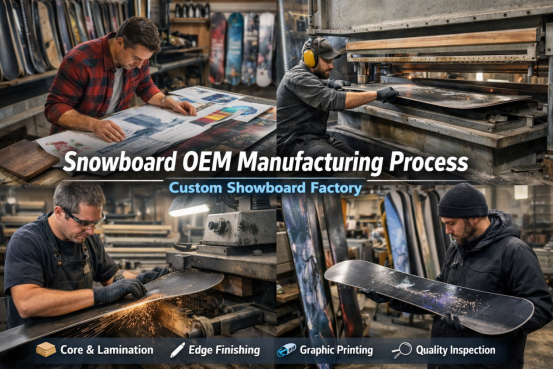
In recent years, the winter sports industry has experienced rapid growth, and snowboarding has become increasingly popular worldwide. As a result, more brands, retailers, and e-commerce sellers are turning to snowboard OEM manufacturers to develop their own snowboard product lines.
But why are so many companies choosing snowboard OEM production, and what does the snowboard manufacturing process actually look like?
In this article, we’ll explore the reasons behind the growing demand for custom snowboard manufacturing and reveal the key steps involved in producing a high-quality snowboard.
For many companies entering the winter sports market, building a snowboard factory from scratch is expensive and complex. Working with an experienced snowboard OEM manufacturer offers a much more efficient solution.
Here are some of the main reasons brands choose OEM production.
Producing snowboards requires specialized equipment, skilled technicians, and high-quality materials. By partnering with a professional snowboard OEM factory, brands can reduce production costs while maintaining high product standards.
OEM factories already have established production lines, which helps optimize manufacturing efficiency and lower overall costs.
Developing a snowboard involves multiple technical stages, including structural design, material testing, and performance evaluation.
Experienced custom snowboard manufacturers can significantly shorten development time by providing:
Professional design assistance
Mature manufacturing processes
Rapid prototype sampling
This allows brands to launch new snowboard models faster.
Many companies want to create their own snowboard brand but do not have the manufacturing capability. OEM production enables businesses to focus on branding, marketing, and distribution while the factory handles production.
Through snowboard customization, brands can design unique graphics, shapes, and performance features that match their target market.
To better understand why OEM factories play such an important role, it’s helpful to look at the typical snowboard production process.
Professional snowboard OEM manufacturers follow a series of precise manufacturing steps to ensure product performance and durability.
The first step is developing the snowboard design. This stage usually includes:
Board shape and profile design
Length and width specifications
Flex and stiffness adjustment
Topsheet graphic design
Engineers also determine the internal structure of the board to achieve the desired riding performance.
The snowboard core is typically made from high-quality wood such as poplar, bamboo, or paulownia.
The wood core is carefully cut, laminated, and shaped to form the structural foundation of the snowboard. A well-designed core ensures proper flex, strength, and stability.
After the core is prepared, additional layers are added to improve durability and performance. These layers may include:
Fiberglass layers
Carbon fiber reinforcement
Resin bonding materials
These materials help enhance the snowboard’s responsiveness and strength.
The layered materials are placed into a snowboard mold and pressed under high temperature and pressure using specialized lamination machines.
This process bonds all layers together and forms the snowboard’s final shape and structure.
Next, manufacturers install the snowboard’s steel edges and base materials.
The base is usually made from high-density polyethylene (P-Tex), which provides excellent glide and durability on snow surfaces.
Steel edges are added to improve control and stability during turns.
Once the board structure is complete, the snowboard enters the finishing stage. This includes:
Base grinding and polishing
Topsheet graphic printing
Edge sharpening
Surface finishing
These processes ensure the snowboard looks attractive and performs well on the snow.
Before shipping, professional snowboard OEM factories conduct strict quality inspections, such as:
Structural strength tests
Flex performance testing
Waterproof and durability testing
Visual inspection for defects
Only snowboards that pass these tests are approved for shipment.
Partnering with a reliable snowboard OEM manufacturer offers several advantages for brands entering the snow sports market:
Professional manufacturing expertise
Consistent product quality
Flexible customization options
Scalable production capacity
Efficient global shipping support
These benefits make OEM production the preferred solution for many snowboard brands.
The growing popularity of snowboarding has created strong demand for custom snowboard manufacturing. As more brands enter the market, working with an experienced snowboard OEM manufacturer has become the most practical way to develop high-quality snowboard products.
Understanding the snowboard production process also helps brands choose the right manufacturing partner and ensure product quality.
If you are planning to launch your own snowboard brand or expand your winter sports product line, partnering with a professional snowboard OEM factory can help turn your ideas into market-ready products.