Home > NEWS > Company News > Views
The global snowboarding industry has grown rapidly over the past decade, attracting many new brands, retailers, and e-commerce sellers. Leading brands such as Burton Snowboards and K2 Snowboards have built their success through strong product innovation and reliable manufacturing partnerships.
For new brands entering the market, working with a snowboard OEM manufacturer is often the fastest way to launch products. However, selecting the wrong factory may result in poor product quality, unstable delivery schedules, and increased costs.
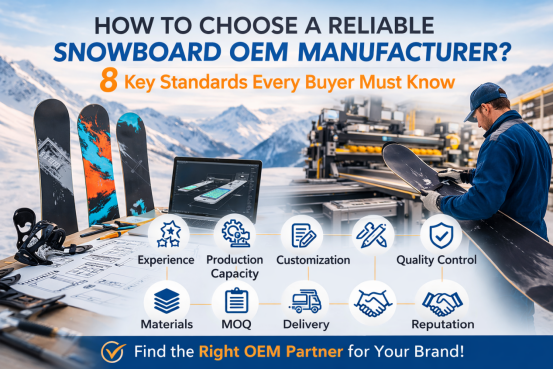
So how can buyers identify a trustworthy snowboard OEM factory? Below are eight essential standards every snowboard brand should evaluate before starting production.
Experience plays a critical role in snowboard manufacturing. Producing high-quality snowboards requires precise control over multiple processes, including:
Wood core shaping
Fiberglass layering
Edge installation
High-pressure pressing
Manufacturers with more than 5–10 years of experience usually have more mature production systems and stable product quality.
A professional snowboard factory should have modern equipment and a stable production line.
Typical snowboard production equipment includes:
CNC core shaping machines
Hydraulic snowboard presses
Base grinding machines
Edge bending machines
Advanced manufacturing equipment ensures consistent quality, efficient production, and faster lead times.
For snowboard brands, product differentiation is key to market success. A reliable snowboard OEM manufacturer should provide flexible customization services, including:
Custom snowboard shapes and flex patterns
Topsheet graphic design
Base color customization
Private label branding
Strong R&D capabilities allow manufacturers to help brands develop competitive products.
Quality control is one of the most important factors when selecting a snowboard manufacturer.
Professional factories implement strict inspection procedures during the entire production process:
Raw material inspection
Core structure testing
Press temperature monitoring
Final flex and durability testing
Many experienced factories also comply with international certifications such as CE or REACH, ensuring products meet global market standards.
High-performance snowboards are built using multiple layers of specialized materials, including:
Poplar or bamboo wood cores
Fiberglass or carbon fiber reinforcement
Sintered or extruded bases
ABS sidewalls
These materials are combined through a high-pressure pressing process to achieve the ideal balance of flexibility, durability, and stability.
MOQ is an important factor for snowboard brands, especially startups.
Typical MOQ ranges include:
50–100 boards per model for smaller factories
300–500 boards per model for large-scale manufacturers
Brands entering the market may benefit from working with manufacturers that offer flexible MOQ policies.
Snowboard products are highly seasonal, which makes delivery timing extremely important.
Reliable manufacturers should provide:
Clear production schedules
Stable raw material supply chains
Professional export logistics support
Delays in production can cause brands to miss the winter sales season.
Finally, evaluate the factory's reputation and previous customer cases.
Important factors include:
Existing international clients
Export markets such as Europe, North America, and Japan
Long-term brand partnerships
Factories with established customers often have more reliable quality control and service systems.
Choosing the right snowboard OEM manufacturer is essential for any snowboard brand or distributor.
By evaluating factors such as manufacturing experience, production equipment, customization capability, quality control, materials, MOQ, delivery capacity, and industry reputation, buyers can greatly reduce risks and build a successful snowboard product line.
A reliable snowboard factory is not just a supplier — it becomes a long-term partner in building your brand.