Home > NEWS > Company News > Views
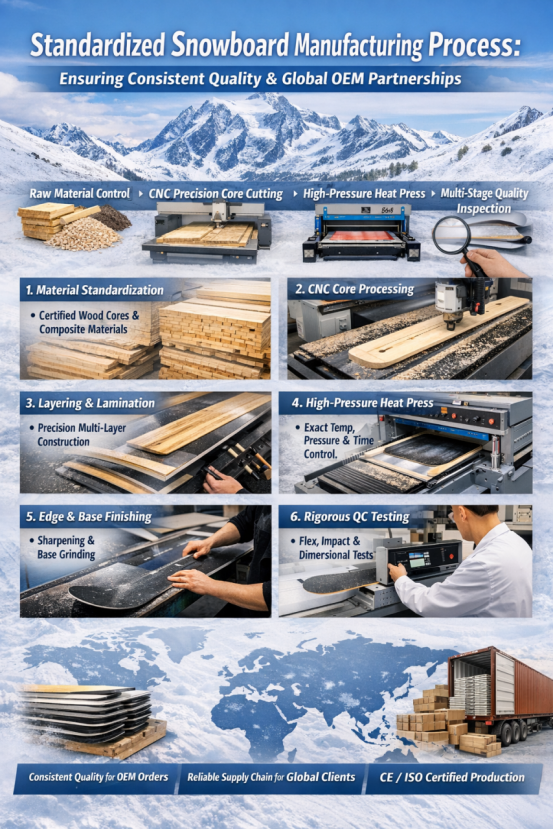
In the rapidly growing global winter sports industry, snowboard buyers—including ski resorts, brands, and distributors—are placing increasing emphasis on product consistency, durability, and supply chain reliability.
Behind these requirements lies one critical factor: a standardized snowboard manufacturing process.
For professional snowboard factories, standardized production is not just a management tool—it is the foundation for delivering high-performance snowboards at scale, especially in OEM and bulk production scenarios.
A snowboard is a multi-layer composite product that requires precision engineering at every stage. Without standardized processes, manufacturers often face:
Inconsistent product quality
Structural defects (delamination, warping)
Unstable performance during use
Increased return and maintenance costs
That’s why global buyers frequently search for:
snowboard manufacturing process
snowboard quality control system
OEM snowboard factory
ski factory standard production
A professional snowboard factory typically follows a fully standardized workflow, covering every stage from raw material selection to final inspection.
Quality starts with controlled material sourcing:
Wood cores (poplar, paulownia, bamboo) with uniform density
Fiberglass and carbon fiber layers with consistent specifications
High-performance base materials (sintered or extruded)
Each batch of materials is:
Tested before production
Categorized by performance level
Recorded for traceability
This ensures consistent input quality, which directly impacts the final product.
The snowboard core defines flex, strength, and responsiveness.
Using CNC machining systems allows:
High-precision shaping of core profiles
Consistent thickness and geometry
Complex structural customization
Standardized CNC programming ensures:
Minimal tolerance deviation
Identical core structure across mass production
Stable performance for every snowboard
Snowboards are built using a sandwich structure that includes:
Core material
Fiberglass or carbon fiber layers
Reinforcement layers (e.g., metal or composite)
Base and topsheet
Through standardized layering procedures:
Material placement is precisely controlled
Structural integrity is ensured
Human error is minimized
Heat pressing is one of the most critical steps in snowboard manufacturing.
A standardized process defines:
Temperature range
Pressure levels
Pressing duration
This ensures:
Strong bonding between layers
No air bubbles or delamination
Stable camber/rocker profiles
Advanced factories also use rapid cooling systems to prevent deformation after pressing.
Precision finishing directly affects riding performance.
Standardized processes include:
Steel edge installation and grinding
Edge angle calibration
Base grinding and structuring
This guarantees:
Smooth turning and control
Reliable edge grip
Consistent glide performance
A professional snowboard factory implements a multi-layer quality control system:
In-process inspection (during production)
Semi-finished product testing
Final product inspection
Testing includes:
Flex and torsion strength
Impact resistance
Dimensional accuracy
Surface quality
Only products that pass all inspections proceed to packaging and shipment.
Standardized production also includes full data recording:
Material batch tracking
Production parameter logs
Inspection reports
This enables:
Fast issue identification
Process optimization
Long-term quality consistency
For global OEM clients, this traceability is essential for compliance and risk control.
For ski resorts, brands, and distributors, standardized factories offer:
Better product durability for rental use
Easier compliance with international standards (CE, ISO)
Stable long-term supply partnerships
Lower operational risks
This is especially important for:
Ski resort rental snowboards
Private label snowboard brands
Wholesale and bulk procurement